
Bridal headpieces: tiara, turban or flowers
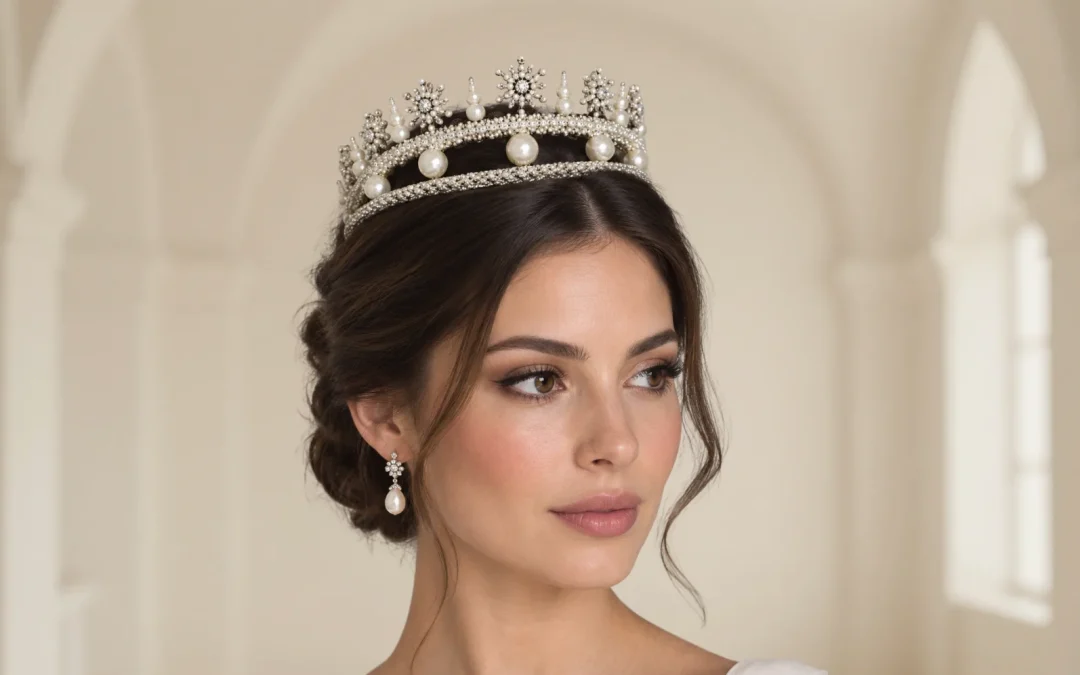
The bridal headpiece is usually the last thing to be chosen and the first thing you notice in the photos. It's there in the close-up at the altar, in the family portrait and in that shot from behind that almost every bride ends up framing. That's why it's worth thinking about early and not leaving it until the final dress fitting.
In our Seville atelier we make tiaras, turbans and floral headpieces for brides, and the questions we get tend to repeat themselves. We've gathered them here: which piece suits each dress and each hairstyle, how to pair it with the veil and when to start looking.
Tiara, turban or floral headpiece: how they differ
All three work at a wedding, but each one says something different about the bride wearing it.
The tiara
It's the most classic piece. It sits on the head, in front of the updo or the loose hair, and frames the face without covering it. For generations it was a family heirloom, and in many families it still is: a few months ago ¡Hola! magazine looked back at the tiaras worn by brides from the Spanish aristocracy, many of them inherited.
Tiaras today are lighter and less rigid in shape, designed also for brides who aren't after a princess look. Our star tiara is discreet and leaves the dress centre stage. The imperial wings tiara has more volume and calls for a simple dress, with no embroidery at the neckline.
The turban
A turban covers part of the head and gathers the hair. It has a strong 1940s feel and looks especially good at civil weddings, on brides with short hair or on anyone who wants to step away from the expected. We make them in light fabrics, like our talc turban, so they don't feel hot or heavy after several hours.
The floral headpiece
It's the most versatile. It can be a small piece on one side of the updo or something larger falling towards the nape. It's perfect for daytime weddings, in the countryside and in spring, although a winter bride can wear one too if the flowers are fabric and in more muted tones. Our floral bridal headpiece is designed to sit to one side and leave the rest of the hairstyle on show.
Choosing it to suit your dress
The dress comes first. Before thinking about the headpiece, look at the neckline and how much embellishment it has.
With a bateau neckline or a high neck, the face and shoulders are already framed. A very large headpiece competes with the dress, and a fine tiara or a small piece to one side usually works better.
A V-neck or strapless dress leaves more space. That's where a piece with volume fits, even a tall tiara or a generous floral headpiece.
If the dress has a lot of embroidery, beading or lace, choose a plain headpiece or one in a single material. If the dress is plain, the headpiece can be the detail that changes the whole look.
There's a rule we repeat a lot in the atelier: shine never doubles up. If the dress sparkles, the headpiece doesn't, and vice versa.
Choosing it to suit your hairstyle
Hair and headpiece are decided together. Many brides settle the hairstyle with their hairdresser and then realise the headpiece has nowhere to be fixed. These are the combinations that work best:
- Low updo: takes almost anything. A tiara at the front, flowers to one side or a piece at the nape.
- High updo or ballerina bun: a tiara looks lovely; a large side headpiece can throw it off balance.
- Loose hair or waves: a tiara or a headband holds better than a comb, which tends to slip in loose hair.
- Short hair: turbans and small headpieces at the temple look best.
If you're having a hair trial, bring the headpiece or at least a photo, and ask your hairdresser to prepare the spot where it will be fixed.
Headpiece and veil: how to pair them
The veil has its own history and symbolism, and these days many brides wear it only for the ceremony and take it off for the reception. If that's your plan, the headpiece should be fixed separately, so that removing the veil doesn't take the hairstyle with it.
The most common approach is to place the veil under the updo and the headpiece on top or in front. With a tiara, the veil usually goes behind and slightly lower. With a turban, brides normally skip the veil or choose a very short one.
If you decide not to wear a veil, the headpiece takes centre stage and you can go for a larger piece.
Daytime or evening, civil or religious
Guests still pay close attention to the time of day when choosing a headpiece. A bride has more freedom, but the light changes how a piece looks. In the morning and outdoors, flowers and matte fabrics shine; in the evening and indoors, metals and subtle sparkle do.
At a church wedding, many brides prefer something classic, such as a tiara with a long veil. At a civil wedding or a country estate there's more room for a turban or a floral headpiece with volume.
When to start looking
Ideally, start once the dress is decided, even if it isn't finished. That way we know the neckline, the fabric and the exact shade of white, which varies enormously from one dress to another. A brilliant-white headpiece next to an ivory dress shows in every photo.
If the headpiece is bespoke, allow for several fittings. We explain how the process works in our guide to ordering a bespoke headpiece. If you'd rather start from a ready-made piece, you can browse our bridal headpiece collection and come in to try them on.
What to bring to your fitting at the atelier
A photo of the dress and, if possible, a fabric swatch. A photo of the hairstyle, even if it's just a reference. The veil, if you already have it. And the earrings you'll be wearing, because they change the look a great deal.
The atelier is at calle Monsalvez 35, in the centre of Seville. We recommend booking an appointment so your fitting can be relaxed, with a mirror and no rush.
